OSHA Accident Investigation for Aerial Lift Safety
OSHA Accident Investigation: Aerial Lift Safety, Near Misses, and Root Cause Analysis
Aerial lift accidents can happen quickly, but the causes usually build over time. A missed inspection, unstable ground condition, poor fall protection setup, rushed operator, weak rescue planning, or lack of proper training can all lead to a serious incident.
That is why OSHA accident investigation is an important part of any aerial lift safety program. After an accident or near miss, employers should look beyond what happened and ask why it happened. The goal is not to blame one worker. The goal is to find the root cause, correct the hazard, and prevent the same problem from happening again.
For companies that use aerial lifts, scissor lifts, boom lifts, or other mobile elevating work platforms, proper training, hands-on evaluation, emergency response procedures, and near miss reporting all work together. AerialLiftCertification.com helps employers train aerial lift operators and build a safer, better-documented lift safety program.
Regulatory Requirements for Aerial Lift Safety
OSHA requires employers to protect workers from recognized hazards, including hazards related to aerial lifts, boom lifts, scissor lifts, fall protection, and working at height.
Aerial lift operators need more than a quick safety talk. Employers should make sure operators understand the equipment, the worksite, fall protection requirements, inspection procedures, emergency controls, and the hazards they may face while working at height.
A complete aerial lift safety process should include:
- Formal instruction: Training on safe operation, fall protection, hazard recognition, inspections, and emergency procedures.
- Equipment familiarization: Instruction on the specific type of lift the worker will use.
- Hands-on evaluation: A qualified person observes the operator using the lift safely in the workplace or a controlled environment.
- Documentation: Employers keep records showing that training and evaluation were completed.
Online training can support the formal instruction portion of the process. However, employers are still responsible for equipment-specific familiarization, hands-on evaluation, workplace-specific instruction, and proper documentation.
Best Practices for Aerial Lift Accident Prevention
The best accident investigation is the one you never need to conduct. Strong prevention practices reduce the chance of falls, tip-overs, electrocution, struck-by incidents, and other serious aerial lift hazards.
Important aerial lift safety practices include:
- Pre-operation inspections: Operators should inspect the lift before use and report defects, leaks, damaged controls, tire issues, guardrail problems, or missing labels.
- Worksite hazard assessment: Employers should evaluate slopes, holes, drop-offs, soft ground, overhead obstructions, power lines, traffic, weather, and pedestrian exposure.
- Operator training: Every operator should receive proper instruction before using an aerial lift, scissor lift, or boom lift.
- Hands-on evaluation: Operators should demonstrate that they can safely use the equipment before working independently.
- Fall protection planning: Workers must understand when harnesses, lanyards, guardrails, and approved anchor points are required.
- Rescue planning: Employers should know how workers will be rescued after a fall, equipment failure, or platform malfunction.
Employers that want to bring training in-house can use ALC’s Aerial Lift Train the Trainer Certification to prepare a qualified employee to support operator training and evaluation.
Common Aerial Lift Hazards
Aerial lift hazards are often obvious after something goes wrong. The hard part is identifying and correcting them before an accident occurs.
Common aerial lift hazards include:
- Falls from height: Falls can happen when workers climb on guardrails, use fall protection incorrectly, exit the platform unsafely, or work from damaged equipment.
- Tip-overs: Lifts can tip when used on unstable ground, steep slopes, uneven surfaces, or in conditions outside the manufacturer’s limits.
- Crushing and entrapment: Operators can be pinned between the platform and beams, ceilings, pipes, racking, or other overhead structures.
- Electrocution: Boom lifts and aerial lifts can expose workers to overhead power lines or energized equipment.
- Falling objects: Tools, materials, or debris can fall from the platform and strike workers below.
- Equipment failure: Poor maintenance can lead to hydraulic issues, control failure, brake problems, steering problems, or emergency descent failure.
Recognizing these risks is the first step. The next step is controlling them through training, inspections, supervision, fall protection, rescue planning, and corrective action.
What Are the Essential Steps in OSHA Accident Investigation?
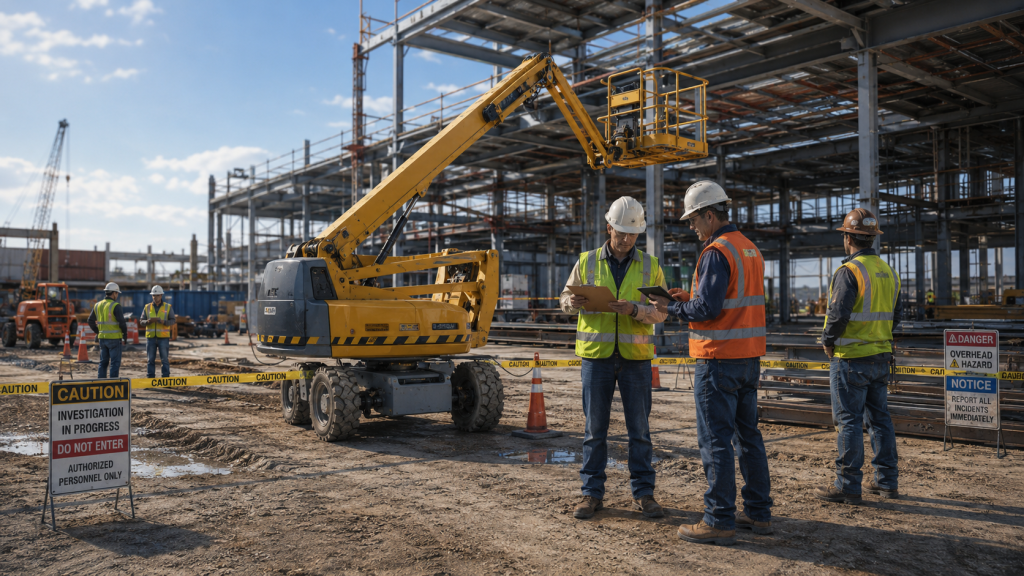
A strong OSHA accident investigation should be timely, organized, and focused on facts. The purpose is to understand what happened, why it happened, and what must change to prevent it from happening again.
After an aerial lift accident or serious near miss, employers should follow these basic steps:
- Respond to the emergency: Make sure injured workers receive help and the area is safe.
- Secure the scene: Keep workers away from hazards and preserve evidence when possible.
- Control elevated hazards: Lower the platform if safe, secure the lift, and protect workers from falling objects, unstable equipment, or electrical hazards.
- Collect information: Take photos, gather witness statements, inspect the lift, review weather conditions, and check training records.
- Identify root causes: Review training, familiarization, supervision, equipment condition, worksite conditions, fall protection, and rescue procedures.
- Take corrective action: Fix hazards, update procedures, retrain workers, repair equipment, or improve site controls.
- Follow up: Confirm corrective actions were completed and actually reduced the risk.
How to Conduct Root Cause Analysis for Aerial Lift Accidents
Root cause analysis, often called RCA analysis, helps employers identify the deeper reasons an incident occurred. Instead of stopping at “the operator made a mistake,” RCA asks what conditions allowed the mistake to happen.
For example, a boom lift may strike an overhead beam because the operator moved the platform too quickly. But root cause analysis may reveal deeper issues, such as poor spotter communication, inadequate worksite assessment, lack of equipment familiarization, production pressure, limited visibility, or weak supervision.
Common RCA tools include:
- 5 Whys analysis: Asking “why” several times to uncover the deeper cause of a problem.
- Fishbone analysis: Also called fish bone analysis or RCA fishbone, this tool organizes possible causes into categories such as people, equipment, environment, process, and training.
- Incident trend review: Looking at past accidents, near misses, inspection findings, and maintenance reports to find repeated problems.
The RCA process should lead to corrective actions that are specific, practical, assigned, documented, and verified.
What OSHA Standards Apply to Aerial Lift Accident Investigations?
OSHA does not have one single “aerial lift accident investigation standard” that covers every possible situation. Instead, several OSHA rules and principles may apply depending on the incident, the equipment, the worksite, and the industry.
For aerial lift operations, employers may need to consider OSHA requirements related to aerial lifts, scaffolds, fall protection, personal protective equipment, electrical hazards, hazard communication, emergency response, recordkeeping, and reporting.
Employers should also understand OSHA reporting requirements. Some serious injuries, hospitalizations, amputations, loss of an eye, and fatalities must be reported to OSHA within required timeframes. Certain work-related injuries and illnesses may also need to be recorded on OSHA forms.
The General Duty Clause may also apply when a recognized hazard exists and the employer fails to take reasonable steps to protect workers.
How Emergency Response Procedures Support Accident Investigations
Emergency response procedures protect workers immediately after an incident. They also help preserve important information for the accident investigation.
A strong emergency action plan should explain what employees need to do during an emergency. This may include who to notify, how to call for medical help, how to use emergency controls, where workers should gather, and how to keep others away from danger.
For aerial lift incidents, emergency preparedness and response may include:
- Stopping work in the affected area
- Checking for injuries
- Calling emergency medical services when needed
- Using ground controls or emergency lowering controls when safe
- Securing the lift and surrounding area
- Keeping workers away from overhead hazards, electrical hazards, and unstable equipment
- Preserving evidence for the investigation
- Notifying supervisors and safety personnel
Emergency response should never put additional workers in danger. Employees should only act within their training and should call professional emergency services when the situation requires it.
Key Emergency Response Steps After an Aerial Lift Incident
After an aerial lift accident or serious near miss, supervisors should act quickly but carefully.
Key steps include:
- Assess the situation: Look for ongoing hazards such as elevated workers, falling objects, unstable equipment, traffic, electrical hazards, or damaged structures.
- Get medical help: Call emergency services if anyone is injured, suspended, trapped, electrically exposed, or unable to safely exit the platform.
- Use emergency controls only if safe: Ground personnel should use emergency descent or ground controls only if they are trained and the action will not create a greater hazard.
- Secure the area: Keep workers, pedestrians, vehicles, and other equipment away until the scene is safe.
- Report the incident: Notify management, safety personnel, and any required outside agencies.
- Begin documentation: Record what happened while details are still fresh.
These steps support both worker safety and the accident investigation process.
Why Near Miss Reporting Is Critical in Aerial Lift Safety
A near miss is an event that could have caused injury, damage, or loss, but did not. Near misses are warnings. When employers take them seriously, they can fix hazards before someone gets hurt.
Near miss reporting is especially important in aerial lift operations because many serious incidents begin as smaller warning signs. A boom lift nearly contacting an overhead power line, a scissor lift shaking on uneven ground, a worker almost falling from a platform, or an operator nearly striking an overhead obstruction should all be treated as opportunities to improve safety.
Near miss reporting helps employers:
- Find hazards before injuries occur
- Improve emergency response procedures
- Identify training gaps
- Strengthen worksite hazard assessments
- Improve fall protection practices
- Improve rescue planning
- Prevent repeat incidents
A near miss may also show that an operator needs refresher training, equipment familiarization, closer supervision, or a change in worksite controls.
What Defines a Near Miss in Aerial Lift Safety?
In aerial lift safety, a near miss is any event that had the potential to cause harm but did not result in injury or damage.
Examples include:
- A boom lift nearly contacting an overhead power line
- A scissor lift almost tipping on uneven ground
- A platform nearly striking a beam, pipe, ceiling, or rack
- A worker almost falling while entering or exiting the platform
- A tool falling from the platform but missing workers below
- An operator discovering damaged guardrails, controls, or emergency descent systems before use
Even if no one is hurt, the incident should still be reported, reviewed, and corrected.
How to Implement Near Miss Reporting Guidelines
Near miss reporting only works when employees feel safe speaking up. If workers think they will be punished for reporting a close call, they may stay quiet. That allows hazards to remain in place.
Effective near miss reporting should include:
- Simple reporting steps: Make it easy for workers to report incidents, hazards, and close calls.
- No-blame culture: Focus on fixing hazards, not punishing honest reporting.
- Fast follow-up: Review reports quickly and take corrective action.
- Trend analysis: Look for repeated patterns over time.
- Employee feedback: Let workers know what changed because of their report.
A strong reporting system turns near misses into useful safety information.
How Aerial Lift Certification Supports Accident Prevention
Aerial lift certification training helps prevent accidents by making sure operators understand equipment hazards, workplace conditions, inspections, fall protection, emergency controls, and safe operating procedures before they begin work.
Training should cover equipment-related and workplace-related topics. That includes lift classifications, controls, platform capacity, ground conditions, stability, guardrails, fall protection, overhead hazards, power line safety, emergency controls, and rescue procedures.
AerialLiftCertification.com provides online aerial lift certification resources designed to help employers train operators and maintain better safety documentation. For companies that want to manage training internally, the Aerial Lift Training Kit can help support formal instruction and employer-led documentation.
What Are the Benefits of Aerial Lift Safety Training?
Aerial lift safety training benefits both employers and workers.
Key benefits include:
- Better hazard awareness: Operators learn how to identify and avoid common aerial lift hazards.
- Stronger documentation: Employers can maintain records showing that workers received training.
- Fewer incidents: Trained operators are more likely to inspect equipment, follow safe procedures, and recognize unsafe conditions.
- Better investigations: Training records help employers review whether instruction, familiarization, or supervision gaps contributed to an incident.
- Improved emergency readiness: Workers are better prepared to respond to lift failures, falls, entrapment, and other emergencies.
- Improved productivity: Skilled operators can work more safely and efficiently.
How Long Is Aerial Lift Certification Valid?
Many employers use a three-year renewal cycle for aerial lift, scissor lift, boom lift, and MEWP training. However, employers should not wait for a calendar date if safety concerns arise sooner.
Refresher training or re-evaluation may be needed when:
- The operator is involved in an accident
- The operator is involved in a near miss
- The operator is seen operating unsafely
- The operator has not used the equipment for an extended period
- The operator is assigned to a different type of lift
- The worksite changes in a way that affects safe operation
- The employer introduces new equipment, attachments, procedures, or hazards
Accident investigations should always include a review of the operator’s training history, equipment familiarization, evaluation records, inspection records, and any previous near miss reports.
How Fall Protection Fits Into Aerial Lift Accident Prevention
Fall protection is one of the most important parts of aerial lift safety. The right fall protection method depends on the equipment, task, worksite, manufacturer instructions, and applicable OSHA requirements.
Boom lift operators commonly need a full-body harness and lanyard attached to an approved anchor point. Scissor lifts are different because guardrails often serve as the primary form of fall protection when they are complete, properly maintained, and used correctly.
Workers should never tie off to guardrails unless the equipment manufacturer specifically allows it. Improper tie-off can create serious hazards, including fall arrest failure or tip-over risk.
Employers should make sure workers understand:
- When fall protection is required
- Which anchor points are approved
- How to inspect harnesses and lanyards
- How to avoid climbing on guardrails
- How to prevent dropped objects
- How rescue will be performed after a fall or platform failure
For teams working at height, aerial lift fall protection training and awareness can help workers better understand fall hazards before they step onto a lift.
Frequently Asked Questions
What is the role of OSHA in aerial lift safety?
OSHA sets and enforces workplace safety requirements. For aerial lifts, scissor lifts, boom lifts, and MEWPs, OSHA requirements may involve training, fall protection, equipment inspection, hazard control, emergency response, and safe operation.
How can employers comply with aerial lift safety requirements?
Employers can comply by training operators, providing equipment familiarization, evaluating workplace hazards, documenting hands-on evaluations, maintaining lift equipment, planning for rescue, and correcting unsafe conditions.
What are the common causes of aerial lift accidents?
Common causes include poor training, unstable ground, unsafe driving, improper fall protection, overhead obstructions, power line contact, equipment defects, weather exposure, and weak supervision.
How does near miss reporting improve workplace safety?
Near miss reporting helps employers find hazards before they cause injuries. It also helps identify patterns, improve training, update rescue plans, and support corrective action.
What should be included in an aerial lift safety training program?
A complete aerial lift safety training program should include formal instruction, equipment familiarization, workplace-specific hazards, safe operating procedures, fall protection, emergency controls, rescue planning, and employer documentation.
How can root cause analysis improve aerial lift safety?
Root cause analysis helps employers find the real reasons an incident happened. By correcting root causes, companies can reduce the chance of repeat accidents.
What should an emergency response plan include for aerial lift incidents?
An emergency response plan should explain how to report incidents, get medical help, use emergency controls, rescue stranded or fallen workers, secure the area, protect employees, and preserve information for the accident investigation.
Conclusion
OSHA accident investigation is about prevention. When employers investigate aerial lift accidents and near misses, they gain information that can help prevent future injuries.
A strong aerial lift safety program should include operator training, hands-on evaluation, equipment inspections, fall protection, emergency response procedures, near miss reporting, root cause analysis, rescue planning, and corrective action. These steps work together to reduce risk and protect workers at height.
AerialLiftCertification.com helps employers build safer aerial lift operations with training resources for operators, in-house trainers, and safety managers. If your team operates scissor lifts, boom lifts, aerial lifts, or MEWPs, proper training and evaluation are two of the best ways to prevent accidents before they happen.