OSHA 10 for Aerial Lift Operators: What It Covers and What Training You Still Need
A new employee arrives at a job site with an OSHA 10 card in their wallet.
They have completed a recognized workplace safety course. They may understand basic fall hazards, electrical safety, personal protective equipment, and emergency procedures.
They may also assume that the card means they are ready to operate a boom lift or scissor lift.
It does not.
An OSHA 10 card shows that a worker completed general hazard-awareness training. It does not prove that they understand a particular lift, know how to inspect it, can position it safely, or can respond when something goes wrong at height.
Before operating an aerial lift, a worker needs training that matches the equipment, the task, and the workplace.
That training should cover more than which buttons move the platform. Operators need to recognize power lines, unstable ground, overhead structures, drop-offs, wind, traffic, fall hazards, crushing hazards, and the limits of the machine.
This guide explains how OSHA 10 relates to aerial lift work, why boom lifts and scissor lifts are not treated exactly the same, and what operators still need before using the equipment independently.
Does OSHA 10 Qualify You to Operate an Aerial Lift?
No.
OSHA 10 is a broad workplace safety course. It helps workers recognize common hazards and understand basic methods for avoiding, controlling, and reporting them.
It is not an aerial lift license.
It is not proof that an employee can safely operate a boom lift, scissor lift, bucket truck, or vertical personnel lift.
It also does not replace the employer’s responsibility to provide training for the equipment and hazards the employee will actually encounter.
Before operating a lift, a worker should receive training on:
- The type of lift being used
- The controls and safety devices
- The manufacturer’s operating instructions
- Pre-use inspections
- Work-area inspections
- Fall protection
- Electrical hazards
- Stability and tip-over hazards
- Platform capacity
- Safe travel and positioning
- Emergency lowering procedures
- Workplace traffic
- Rescue and emergency response
The employer should also confirm that the worker can apply the training safely.
Knowing the answer on a written quiz is useful. Safely positioning a lift near a ceiling beam, power line, loading area, or uneven surface requires practical judgment.
What Is OSHA 10?
OSHA 10 is an entry-level safety course offered through OSHA’s Outreach Training Program.
The program introduces workers to:
- Common workplace hazards
- Employee rights
- Employer responsibilities
- Hazard reporting
- OSHA complaint procedures
- Emergency preparedness
- Personal protective equipment
- Hazard prevention and control
The course is designed to build awareness.
It does not provide detailed qualification for every machine or task a worker may perform.
OSHA describes the 10-hour course as appropriate for entry-level workers. The 30-hour course provides greater depth and may be a better fit for supervisors, lead workers, safety coordinators, and employees with broader safety responsibilities.
Should Aerial Lift Operators Take OSHA 10 Construction or General Industry?
It depends on the work being performed.
Aerial lifts are used in many settings, including:
- Construction sites
- Manufacturing plants
- Warehouses
- Retail facilities
- Building maintenance
- Telecommunications
- Utilities
- Sign installation
- Industrial maintenance
- Entertainment venues
- Tree care
- Property management
A worker performing construction, alteration, or repair work may be directed to take OSHA 10 Construction.
A worker using a lift in a warehouse, manufacturing plant, retail facility, or another fixed workplace may be directed to take OSHA 10 General Industry.
The equipment itself does not always determine which course is appropriate.
The job, industry, contract, location, and employer requirements all matter.
An electrician using a boom lift during new construction may need OSHA 10 Construction. A maintenance employee using the same type of lift inside a manufacturing plant may be covered by general industry requirements.
Workers should confirm which course their employer, contractor, site owner, union, or jurisdiction accepts.
Is OSHA 10 Required for Aerial Lift Operators?
Federal OSHA generally treats the Outreach Training Program as voluntary.
However, an employer, general contractor, state, municipality, union, facility owner, or insurance provider may require an OSHA 10 card as a condition of employment or site access.
Even when an OSHA 10 card is required, equipment-specific training is still necessary.
An operator may need:
- General workplace orientation
- Aerial lift or scissor lift training
- Fall-protection training
- Personal protective equipment training
- Electrical-hazard training
- Hazard communication training
- Traffic-control instruction
- Emergency and rescue procedures
- Site-specific orientation
- Task-specific training
OSHA 10 gives the worker a broad foundation.
Aerial lift training teaches the worker how to use the equipment without being thrown from the platform, crushed against a structure, electrocuted, or tipped over.
What Counts as an Aerial Lift?
The term “aerial lift” is often used loosely.
Workers may use it to describe almost any machine that raises a person above the ground.
That can create confusion because OSHA does not treat every elevated work platform in exactly the same way.
Equipment commonly called an aerial lift includes:
- Articulating boom lifts
- Telescopic boom lifts
- Bucket trucks
- Towable boom lifts
- Vertical towers
- Scissor lifts
- Vertical mast lifts
- Personnel lifts
The safest starting point is to identify the exact machine before deciding what standards, training, fall protection, and operating rules apply.
Boom Lifts and Scissor Lifts Are Different
Boom lifts use an extending or articulating boom to move the platform upward and outward.
Examples include:
- Articulating boom lifts
- Telescopic boom lifts
- Bucket trucks
- Trailer-mounted boom lifts
A boom lift can place the platform away from the machine’s base. This makes the equipment useful for reaching over obstacles, but it also creates hazards involving ejection, movement, stability, and entrapment.
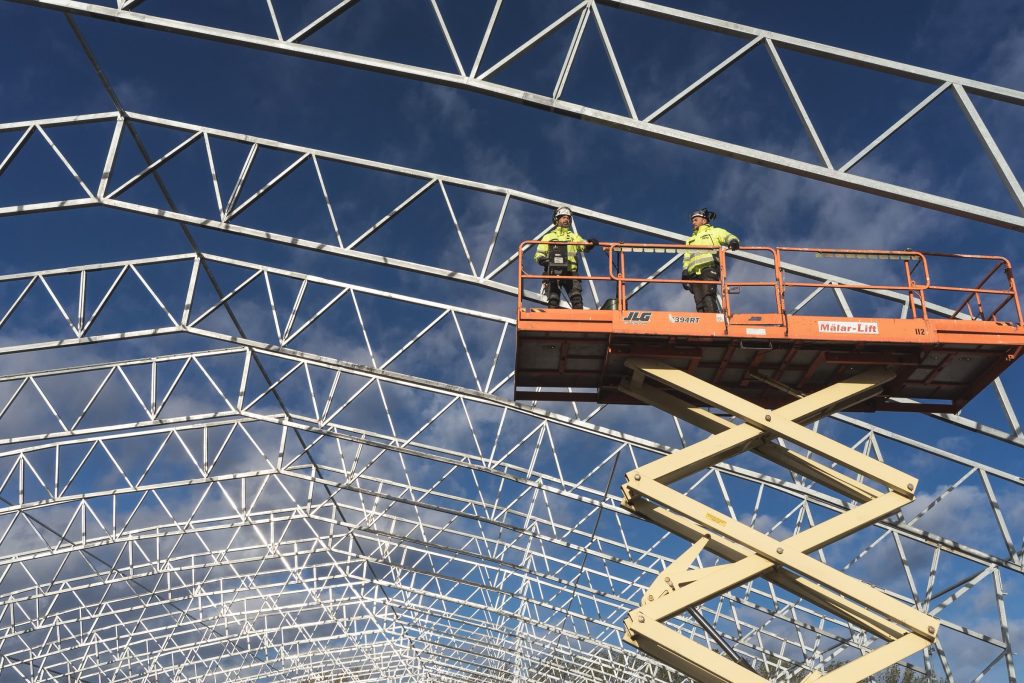
Scissor lifts use crossed supports to move a platform mainly straight up and down.
They are commonly used for:
- Electrical installation
- Lighting work
- Ceiling maintenance
- Painting
- Inventory work
- Mechanical installation
- Sign work
- Indoor facility maintenance
OSHA commonly regulates scissor lifts as mobile scaffolds rather than as boom-supported aerial lifts.
That distinction matters because the standards and fall-protection requirements may differ.
An operator should never assume that a rule learned for a scissor lift automatically applies to a boom lift, or that a boom-lift rule applies to every scissor lift.
What Does OSHA 10 Teach That Helps Aerial Lift Operators?
OSHA 10 does not qualify someone to operate a lift, but many course topics are directly relevant.
Introduction to OSHA
This section explains employee rights, employer responsibilities, hazard reporting, and the purpose of OSHA inspections.
For an aerial lift operator, the practical question is:
“What should I do when the job cannot be performed safely?”
That might happen when:
-
The lift has a damaged guardrail
-
The emergency controls do not work
-
The ground is soft or uneven
-
Wind is increasing
-
A power line is too close
-
The platform gate will not close
-
The lift is leaking hydraulic fluid
-
The work area cannot be isolated from traffic
-
The task requires overreaching
-
The correct fall-protection equipment is unavailable
-
No one knows how to lower the platform in an emergency
A trained operator should know how to stop the task, report the condition, and request help.
Speaking up is not refusing to work. It is part of operating responsibly.
Fall Hazards
Falls are one of the most obvious aerial lift hazards, but they do not happen only when someone steps off the platform.
An operator may be thrown or pulled from the platform because of:
- Sudden machine movement
- Contact with an obstruction
- Driving over a hole or bump
- Being struck by another vehicle
- Improper tie-off
- Climbing on the guardrails
- Using a ladder inside the platform
- Overreaching
- A tip-over
- Equipment failure
Operators need to understand how the lift’s guardrails, gates, anchor points, and personal fall-protection systems work together.
They also need to know that fall-protection rules can differ between boom lifts and scissor lifts.
Electrical Safety
A lift does not need to touch a power line for someone to be electrocuted.
Electricity can arc through the air when equipment or workers get too close to an energized line.
Operators may also misjudge distance because they are looking upward from an angle or because the platform moves as the boom extends.
Electrical training should address:
- Overhead power lines
- Minimum approach distances
- Energized equipment
- Conductive tools and materials
- Wind and platform movement
- Using a spotter
- Electrical work permits
- De-energizing and grounding
- Site-specific electrical procedures
A common rule is to maintain at least 10 feet of clearance from overhead power lines unless the applicable electrical requirements call for more.
The safest option is to have the lines de-energized and properly controlled before work begins whenever possible.
Personal Protective Equipment
Aerial lift operators may need:
- A full-body harness
- A lanyard or self-retracting lifeline
- A travel-restraint system
- A personal fall-arrest system
- A hard hat
- Eye protection
- High-visibility clothing
- Safety footwear
- Gloves
- Hearing protection
The required PPE depends on the equipment, work environment, manufacturer instructions, and applicable standard.
Training should explain:
- What equipment is required
- How to inspect it
- How to put it on
- Where to connect it
- Which anchor points may be used
- How much clearance is needed
- How to avoid swing hazards
- How to recognize damaged equipment
- What the equipment cannot protect against
A harness is not useful if it is connected to the wrong point, adjusted incorrectly, or paired with an unsuitable lanyard.
Emergency Procedures
An operator may be elevated when the machine loses power, a control fails, weather changes, or the operator becomes ill.
Workers should know:
- How to use the platform controls
- How to use the ground controls
- Where the emergency lowering controls are located
- Who is authorized to operate the ground controls
- How to contact emergency services
- How to keep the area below clear
- What to do after electrical contact
- How the employer will rescue an incapacitated worker
Someone on the ground should understand how to lower the platform.
Waiting until a worker is trapped 40 feet in the air is not the right time to open the manual for the first time.
Does OSHA 10 Include Aerial Lift Certification?
OSHA 10 may discuss fall protection, scaffolds, electrical safety, equipment hazards, or struck-by hazards.
It does not complete aerial lift operator training.
A course may include an aerial lift example without teaching:
- The controls of a particular machine
- The difference between platform and ground controls
- How the emergency-lowering system works
- The machine’s load capacity
- Its wind limitations
- How slope affects stability
- How to inspect the equipment
- How to position it near obstructions
- How to recognize crushing hazards
- How the manufacturer permits elevated travel
A general course can explain that overhead power lines are dangerous.
Equipment-specific training teaches the operator how the lift moves, how far the platform may drift, and how to maintain clearance while positioning the machine.
What Should Aerial Lift Operator Training Include?
A complete operator-training program should include formal instruction, practical training, equipment familiarization, and a demonstration of safe operation.
Formal Instruction
Formal instruction may be provided through:
- Classroom teaching
- Online learning
- Videos
- Written materials
- Group discussion
- Interactive exercises
- Manufacturer materials
Topics should include:
- Equipment types
- Controls and safety devices
- Manufacturer warnings
- Inspections
- Platform capacity
- Stability
- Fall protection
- Electrical hazards
- Wind and weather
- Traffic
- Crushing and entrapment
- Emergency procedures
- Safe travel
- Ground conditions
- Work-area setup
- Prohibited practices
Formal training gives the operator the knowledge needed to understand the risks.
It does not replace practical experience.
Practical Training
Practical training allows the worker to use the equipment under supervision.
The trainee should practice:
- Starting and shutting down
- Selecting platform or ground controls
- Raising and lowering the platform
- Steering and driving
- Positioning the lift
- Using outriggers when applicable
- Testing emergency controls
- Reading warning indicators
- Approaching the work area
- Maintaining clearance
- Parking and securing the equipment
- Performing a pre-use inspection
Practice should take place in a controlled area before the operator works near traffic, structures, power lines, or other employees.
Familiarization With the Specific Lift
Two lifts that look similar may have different controls, warning systems, capacities, dimensions, and emergency procedures.
Before operating an unfamiliar model, the worker should review:
- The operator’s manual
- Control functions
- Emergency controls
- Safety devices
- Warning lights
- Alarm systems
- Platform capacity
- Maximum slope
- Wind rating
- Travel restrictions
- Fall-protection anchor points
- Manufacturer limitations
An operator may have years of experience and still need familiarization with a machine they have never used.
Experience does not make every control panel identical.
Demonstrating Safe Operation
The employer should confirm that the operator can use the lift safely.
A practical demonstration may include:
- Inspecting the lift
- Inspecting the work area
- Selecting the correct fall protection
- Entering and exiting the platform
- Operating the controls smoothly
- Maintaining clearance
- Positioning the platform
- Recognizing overhead hazards
- Following capacity limits
- Responding to an alarm
- Using emergency controls
- Parking and securing the machine
The purpose is not to make the operator nervous.
It is to find gaps while a trainer is present, rather than discovering them during an emergency.
The Major Hazards Aerial Lift Operators Need to Understand
Falls and Ejection
A worker may fall from a platform after climbing on a rail, leaning too far, leaving the gate open, or using a makeshift device to gain height.
A worker may also be ejected when the lift:
- Hits a pothole
- Strikes an object
- Is hit by a vehicle
- Stops suddenly
- Moves over uneven ground
- Is operated too aggressively
- Tips or shifts unexpectedly
Operators should keep both feet on the platform floor.
They should never stand on:
- Guardrails
- Boxes
- Buckets
- Ladders
- Planks
- Materials
- Makeshift platforms
When the platform is not high enough, the answer is not to climb higher inside the basket.
The answer is to select equipment with the correct working height and reach.
Tip-Overs
A lift can tip because of:
- Excessive slope
- Soft soil
- Holes
- Drop-offs
- Improper outrigger setup
- Excessive wind
- Overloading
- Sudden movement
- Driving while elevated
- Contact with another vehicle
- Using the machine outside its design limits
The higher the platform rises, the more important ground conditions become.
A small slope at ground level may feel much larger when the operator is elevated.
Operators should never assume that concrete, asphalt, soil, or a floor can support the machine simply because it looks solid.
Crushing and Entrapment
Aerial lift operators can become trapped between the platform and:
- Ceiling beams
- Roof structures
- Door frames
- Pipes
- Ductwork
- Shelving
- Walls
- Equipment
- Tree limbs
- Steel members
The operator may unintentionally continue moving because the controls are pressed against their body or an obstruction.
Operators should move slowly near overhead structures and keep an escape path in mind.
A spotter may be needed when visibility or clearance is limited.
Ground personnel should also know how to use the emergency controls if the operator becomes trapped or cannot respond.
Electrocution
Electrical contact may occur when:
- The boom touches a power line
- A worker touches a line
- A conductive tool contacts a line
- Electricity arcs to the platform
- The machine is positioned too close to energized equipment
- The operator misjudges distance
- Wind moves the boom or line
Workers should treat power lines as energized unless the utility or responsible authority has confirmed otherwise and proper controls are in place.
A spotter can help monitor clearance, but the operator remains responsible for stopping when the required distance cannot be maintained.
Falling Objects
Tools and materials can fall from the platform and strike people below.
Controls may include:
- Barricading the area
- Using tool restraints
- Securing materials
- Wearing head protection
- Using toe boards when required
- Limiting access
- Avoiding work directly above others
The platform should not become a storage shelf.
Loose tools, fasteners, packaging, and materials can shift when the machine moves.
Collision Hazards
A lift may collide with:
- Forklifts
- Trucks
- Cranes
- Building columns
- Racks
- Doors
- Walls
- Other lifts
- Pedestrians
Traffic control may include:
- Barricades
- Cones
- Spotters
- Signs
- Restricted access
- Temporary shutdowns
- High-visibility clothing
- Communication with nearby operators
Aerial lift work should not quietly appear in the middle of an active traffic lane with no warning.
Before You Use the Lift
A pre-use inspection helps find equipment problems before the operator leaves the ground.
The exact checklist should follow the manufacturer’s instructions.
Common inspection items include:
- Platform controls
- Ground controls
- Emergency lowering controls
- Guardrails
- Entry gate
- Anchor points
- Wheels and tires
- Outriggers and stabilizers
- Hydraulic hoses
- Electrical cables
- Batteries
- Fuel system
- Steering
- Brakes
- Alarms
- Lights
- Limit switches
- Emergency stop
- Warning labels
- Capacity markings
- Structural components
- Pins and fasteners
- Visible leaks
- Damage or unauthorized modifications
The operator should test the controls before use.
If a safety device does not work, the machine should not be used until it has been properly addressed.
Inspect the Work Area Too
A safe lift can become unsafe in the wrong location.
Before positioning the machine, look for:
- Power lines
- Ceiling beams
- Door frames
- Pipes
- Ductwork
- Holes
- Drop-offs
- Slopes
- Soft soil
- Floor openings
- Debris
- Curbs
- Uneven surfaces
- Vehicle traffic
- Pedestrians
- Poor lighting
- Wind
- Rain
- Ice
- Restricted access
- Underground structures
- Floor-load limitations
The operator should also consider how the machine will reach and leave the work area.
A path that is clear when the lift enters may be blocked later by deliveries, vehicles, materials, or other equipment.
Fall Protection for Boom Lifts
Workers using boom-supported aerial lifts generally need a personal fall-arrest or travel-restraint system attached to the boom or basket at the approved anchor point.
The operator should follow:
- The applicable OSHA requirements
- Manufacturer instructions
- The employer’s fall-protection program
- Equipment-specific anchor-point markings
The worker should not tie off to:
- A nearby structure
- A pipe
- A guardrail that is not an anchor point
- Another piece of equipment
- An unknown attachment point
The selected system should match the task and the equipment.
A travel-restraint system is designed to prevent the worker from reaching a fall position.
A fall-arrest system is designed to stop a fall after it begins.
Those systems have different clearance, equipment, and rescue considerations.
Fall Protection for Scissor Lifts
Scissor lifts are commonly protected by a guardrail system.
When the guardrails are complete, properly maintained, and used as intended, OSHA’s construction scaffold rules do not automatically require the worker to tie off.
However, the operator must remain inside the rails and follow safe work practices.
That means:
- Keep both feet on the platform
- Keep the gate closed
- Do not climb on the rails
- Do not use a ladder inside the platform
- Do not lean outside the platform
- Keep work within comfortable reach
- Follow the manufacturer’s instructions
- Follow the employer’s fall-protection policy
A manufacturer, employer, site owner, or task-specific rule may require personal fall protection in addition to the guardrails.
Operators should not guess.
They should know the requirements before raising the platform.
Capacity Limits
The platform-capacity rating includes more than the operator’s body weight.
It may include:
- Workers
- Tools
- Materials
- Equipment
- Personal protective equipment
- Parts being installed or removed
Operators should never exceed the manufacturer’s load limit.
They should also consider how the load is distributed.
A heavy object placed at one end of the platform may affect stability differently from the same weight spread evenly.
The guardrails should not be used to support suspended loads unless the machine is specifically designed and approved for that purpose.
Wind and Weather
Wind can change quickly, especially at height.
Buildings, roofs, and structures can create gusts that are stronger than the wind felt at ground level.
Operators should follow the manufacturer’s wind rating and employer procedures.
They should stop work when:
- Wind approaches the machine’s limit
- Gusts affect platform control
- Lightning is present
- Rain creates slippery conditions
- Ice or snow affects movement
- Visibility becomes poor
- The surface becomes unstable
Do not rely on one generic wind-speed rule for every lift.
Indoor-only equipment may have no outdoor wind rating at all.
Can You Drive With the Platform Elevated?
Only when the machine is designed for elevated travel and the manufacturer permits it under the conditions present.
Even when elevated travel is allowed, the operator must consider:
- Surface condition
- Slope
- Holes
- Drop-offs
- Overhead clearance
- Traffic
- Speed
- Wind
- Platform height
- Manufacturer restrictions
Many tip-overs and crushing incidents happen while a lift is moving.
The ability to drive while elevated does not mean it is safe to do so everywhere.
Emergency Lowering and Rescue
Every operator should know how the platform can be lowered if the normal controls fail.
Ground personnel should know:
- Where the lower controls are located
- How to activate them
- How to use the emergency-lowering system
- When not to move the lift
- How to contact emergency services
- What to do after electrical contact
- How to keep others away from the equipment
The employer should have a rescue plan that fits the work.
Calling emergency services may be part of that plan, but it should not be the only thought given to rescue.
A suspended or trapped worker may need help before outside responders arrive.
When Is Retraining Needed?
There is no single federal expiration date that automatically applies to every aerial lift training card.
Retraining may be needed when:
- The operator uses the equipment unsafely
- An accident or near miss occurs
- The operator does not understand a critical procedure
- The workplace changes
- A new hazard is introduced
- The operator is assigned a different type of lift
- The equipment has different controls or limitations
- The employer has reason to question the operator’s ability
- Safety procedures or manufacturer instructions change
For construction work involving scissor lifts, retraining is required when changes or performance show that an employee no longer has the necessary understanding or skill.
Employers should not wait for a card to reach an arbitrary date when unsafe operation is already visible.
Can Online Training Complete the Entire Process?
Online training can provide formal instruction.
It can teach:
- Hazard recognition
- Equipment categories
- Fall protection
- Stability
- Electrical safety
- Inspections
- Capacity
- Emergency procedures
- Prohibited practices
It cannot give a worker physical experience with the machine.
An operator still needs to understand the controls, practice with the equipment, inspect the work area, and demonstrate safe use.
A video can show how emergency lowering works.
The operator and ground personnel still need to locate and understand the actual emergency controls on the machine they will use.
Who Can Train Aerial Lift Operators?
The trainer should have the knowledge, experience, and ability needed to teach the equipment and hazards involved.
A qualified trainer should be able to:
- Explain the standards and safe practices
- Understand the manufacturer’s instructions
- Demonstrate the controls
- Identify unsafe conditions
- Supervise practical operation
- Correct unsafe behavior
- Evaluate whether the worker understands the equipment
- Explain emergency procedures
A person may be an experienced operator without being prepared to train others.
Training requires more than saying, “Watch what I do.”
The trainer should be able to explain why a practice is safe, recognize when conditions have changed, and stop the exercise when necessary.
A Practical Training Sequence for Aerial Lift Operators
Step 1: Identify the work and equipment
Determine:
- Whether the work is construction or general industry
- Whether the machine is a boom lift, scissor lift, bucket truck, or another platform
- Which standards and employer rules apply
- What tasks the operator will perform
Step 2: Complete general safety orientation
Review:
- Worker rights
- Hazard reporting
- Emergency procedures
- PPE
- Electrical safety
- Fall hazards
- Site rules
OSHA 10 may be part of this step.
Step 3: Complete formal lift instruction
Learn the hazards, controls, safety systems, capacity limits, inspection procedures, and safe operating practices.
Step 4: Review the specific machine
Locate and understand:
- Platform controls
- Ground controls
- Emergency stops
- Emergency lowering
- Anchor points
- Capacity information
- Warning labels
- Manufacturer limitations
Step 5: Inspect the machine
Complete the required pre-use inspection and report any defects.
Step 6: Inspect the work area
Look for electrical hazards, traffic, unstable ground, drop-offs, obstructions, weather, and access restrictions.
Step 7: Practice under supervision
Operate the controls in a safe area and practice normal and emergency procedures.
Step 8: Demonstrate safe operation
Show that you can inspect, position, operate, lower, park, and secure the machine safely.
Step 9: Receive employer authorization
Do not operate independently until the employer has determined that you are trained and authorized for the assigned equipment and work.
Step 10: Stop when conditions change
Reassess the task when wind increases, traffic enters the area, the ground changes, an alarm activates, or the work can no longer be reached safely.
Common Misunderstandings
“I have an OSHA 10 card, so I can operate a lift.”
OSHA 10 is general hazard-awareness training.
It does not replace equipment-specific operator training.
“A scissor lift and a boom lift follow the same rules.”
They may present similar hazards, but OSHA does not classify them in exactly the same way.
Fall-protection and operating requirements may differ.
“Guardrails mean I can climb on the platform edge.”
Guardrails are designed to prevent falls.
They are not steps, seats, ladders, or work platforms.
“I only need a harness when I am very high.”
Fall-protection requirements are based on the equipment and applicable rules, not simply on whether the operator feels high enough to be in danger.
“The lift is insulated, so power lines are not a concern.”
Insulation does not remove every electrical hazard.
Workers must still maintain required clearances and follow electrical-safety procedures.
“If the platform reaches the work, the lift is suitable.”
The lift must also have the correct capacity, stability, working height, horizontal reach, wind rating, and operating environment.
“Online training is all I need.”
Online instruction can teach the knowledge portion.
Hands-on training and equipment familiarization are still necessary.
“I have operated lifts for years, so I can use any model.”
A new model may have different controls, safety devices, capacities, alarms, and emergency procedures.
Experienced operators still need familiarization.
Frequently Asked Questions
Does OSHA 10 certify me to operate an aerial lift?
No.
An OSHA 10 card documents completion of a general safety course. It is not an aerial lift license or operator qualification.
Should I take OSHA 10 Construction or General Industry?
The correct course usually depends on the work setting and the type of work being performed.
Construction, alteration, and repair work may call for OSHA 10 Construction. Work in manufacturing, warehousing, retail, or facility operations may call for General Industry.
Is a scissor lift considered an aerial lift?
The term is commonly used that way in everyday conversation.
Under OSHA’s construction framework, scissor lifts are generally treated as mobile scaffolds rather than boom-supported aerial lifts.
Is a harness always required in a scissor lift?
Not automatically under every circumstance.
A properly maintained guardrail system commonly provides the required fall protection. Manufacturer instructions, employer rules, site requirements, or specific hazards may require additional protection.
Is fall protection required in a boom lift?
Workers using a boom-supported aerial lift generally need an appropriate personal fall-arrest or travel-restraint system attached to the designated point on the boom or basket.
Can I stand on the guardrails?
No.
Keep both feet on the platform floor. Do not use rails, ladders, boxes, planks, or other devices to gain height.
Can I drive a lift while elevated?
Only if the machine is designed for elevated travel and the manufacturer permits it under the conditions present.
How close can a lift get to a power line?
A common minimum clearance is 10 feet, but greater distances may be required depending on voltage, work type, and applicable electrical standards.
Can I use a lift outside?
Only if the machine is rated for outdoor use and conditions remain within the manufacturer’s limitations.
Check wind, ground conditions, slope, weather, and traffic.
Does aerial lift training expire?
There is no single federal expiration date that applies to every aerial lift training record.
Retraining should occur when equipment, hazards, conditions, or operator performance create a need.
Do I need training for every lift model?
You may not need to repeat an entire course for every similar machine, but you need familiarization with controls, safety devices, limitations, and emergency procedures that differ.
What should I do if the controls do not work correctly?
Stop using the machine.
Report the defect and follow the employer’s procedure for removing unsafe equipment from service.
Can I leave an elevated platform to step onto a roof or structure?
Do not climb out unless the employer has developed a specific procedure, the equipment and manufacturer allow it, and all fall-protection and access hazards have been addressed.
Routine climbing from the platform to another surface should not be improvised.
OSHA 10 and Aerial Lift Training Serve Different Purposes
OSHA 10 gives workers a broad understanding of workplace safety.
It helps them recognize falls, electrical hazards, emergency conditions, PPE needs, and unsafe work practices.
Aerial lift training goes deeper.
It prepares the operator to inspect a particular machine, understand its controls, position it safely, maintain clearance, prevent tip-overs, avoid entrapment, and respond when something goes wrong.
A complete training process should include:
- General hazard awareness
- Site-specific orientation
- Equipment-specific instruction
- Manufacturer familiarization
- Hands-on practice
- Fall-protection training
- Emergency procedures
- Demonstration of safe operation
- Employer authorization
- Retraining when conditions show a need
The goal is not simply to carry another card.
The goal is to make sure the operator can look at the machine, the task, the ground, the weather, the power lines, and the surrounding work area, then make a safe decision before raising the platform.
OSHA 10 can begin that conversation.
Proper aerial lift training carries it all the way to the work at height.